
Plastic Pallets vs. Wood Pallets for Export and Warehouse Use

Updated: Aug 5
Wood pallets remain common, but plastic pallets can be a better operational fit when consistency, cleanliness, export handling or repeat use matters. The right choice depends on the lane, load, equipment and number of trips—not on material alone.
This buyer’s guide helps procurement and warehouse teams compare plastic and wood pallets using the factors that affect total operating cost.
Quick comparison
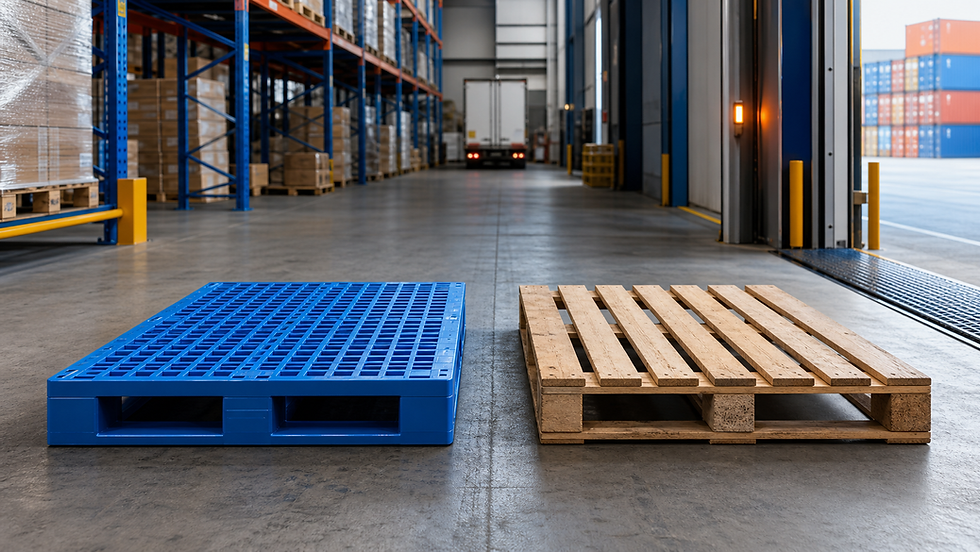
Plastic pallets: consistent dimensions, no splinters or protruding nails, washable surfaces and predictable tare weight. They are often selected for closed-loop systems, hygiene-sensitive environments, automation and recurring export lanes.
Wood pallets: widely available, easy to repair in many markets and often economical for one-way or low-control shipments. Their condition and dimensions can vary more from pallet to pallet.
1. Define the handling system
Start with how the pallet will move. List forklift and pallet-jack entry requirements, conveyor and chain spacing, racking support points, automated storage interfaces and the expected orientation. A pallet that works on a warehouse floor may not be suitable for unsupported rack spans or a particular conveyor.
Ask the supplier for static, dynamic and racking load guidance, then describe the real load footprint. A uniformly distributed carton load behaves differently from drums, bulk bags or a dense machine component.
2. Separate purchase price from cost per trip
For reusable lanes, compare the cost over the expected number of cycles. Include loss rate, breakage, repair, cleaning, storage, reverse logistics and product damage. A higher initial price can make sense when the pallet returns reliably and reduces handling variation; it may not make sense when the pallet is unlikely to come back.
A simple business case should use conservative assumptions. Test a small fleet, track actual trips and damage, and update the model before a large conversion.
3. Consider export and border requirements
Wood packaging used in international trade may require treatment, marking or documentation depending on the destination and shipment. Plastic pallets avoid wood-specific issues, which can simplify recurring export programs. Always confirm current route-specific requirements with the freight forwarder, broker or relevant authority.
For export programs, also consider pallet weight, nesting ratio, return feasibility and whether the receiving customer can handle the selected design.
4. Match hygiene and cleaning needs
Plastic pallets do not absorb moisture in the same way as untreated wood and can be designed with smooth, accessible surfaces. That can make them easier to clean and inspect. However, “plastic” does not automatically mean suitable for every food, pharmaceutical or clean-room use. Confirm the resin, design, cleaning method and any required declarations for the application.
If washdown is important, evaluate drain paths, hollow areas, welded seams and places where residue may collect.
5. Check automation and dimensional consistency
Automated conveyors, wrappers, dispensers and ASRS equipment benefit from repeatable pallet geometry. Confirm overall dimensions, fork openings, deck height, runner design and allowable deflection. Sample pallets should be tested on the actual system with the actual load.
Run entry tests with every forklift and pallet-jack type.
Test conveyor transfers, stops, centering devices and pallet dispensers.
Confirm barcode or RFID placement and scan reliability.
Measure deflection at the expected temperature and load.
Check stacking and nesting stability during storage and transport.
6. Review safety, fire and facility policies
Pallet material and design can affect fire protection, insurance and storage practices. Before changing a large pallet fleet, review the proposed pallet with the facility’s safety team, insurer and fire-protection specialist. Confirm applicable policies for indoor storage, high-piled storage and sprinkler design.
When plastic is usually the stronger fit
Closed-loop distribution with a reliable return flow.
Automated handling that needs consistent dimensions.
Washable or inspection-sensitive operations.
Recurring export shipments where wood-specific requirements create friction.
Applications where splinters, nails or loose wood debris are unacceptable.
When wood may still be practical
Wood can remain sensible for one-way shipments, irregular lanes, local repair networks or loads that need a simple custom footprint at low volume. The goal is not to replace every wood pallet; it is to select the format that produces the lowest risk and cost for each lane.
Build a better pallet RFQ
Include pallet dimensions, load weight and footprint, static/dynamic/racking conditions, rack span, conveyor details, fork entry, operating temperature, nesting or stacking needs, export destinations, annual quantity, colour, identification and any compliance documents required by the customer.
Explore JOIN Plastic’s industrial plastic pallet options, then request a pallet recommendation and quotation with your load and handling details.


Comments